The Core Concept
The foundation of the perfect MarTech stack is built on three critical principles: avoiding vendor lock-in, the ability to scale operations, and the capacity to incrementally grow your capabilities.
This approach mirrors the evolution of headless websites, where the presentation layer is decoupled from the content management system. In marketing technology, we apply the same principle: create a decoupled infrastructure where an intermediary layer sits between your marketing operations and your technology providers. This separation grants you the freedom to exchange solutions, scale specific components independently, and introduce new functionality as requirements change—all while maintaining operational continuity. Perhaps most importantly, it enables you to compare and contrast vendors and solutions side-by-side, running parallel implementations to evaluate performance, cost, and fit before committing to a single provider.
The Perfect MarTech Stack enables you to escape vendor lock-in, scale operations independently, and incrementally expand your capabilities—giving you full control over your marketing technology investments.
The Benefits of a Modular Approach
The primary advantage of this architecture is that you implement only the components and features that matter to your operations. You control the prioritization—deciding which tools to adopt, when to adopt them, and how deeply to integrate them. When you want to experiment with emerging technologies or test innovative approaches, you have the infrastructure in place to make it happen without overhauling your entire system.
This doesn't mean you must build everything from scratch. The beauty of this approach is choice: you can develop custom solutions when they provide competitive advantage, leverage existing vendor solutions when they meet your needs, or pilot new tools with minimal risk. For mission-critical functions, you might invest in best-of-breed solutions that excel in their domain. For emerging needs or experimental initiatives, you can start with more cost-effective options and upgrade as requirements solidify.
Vendor-Agnostic Abstraction: Running Parallel Solutions
One of the most powerful aspects of this architecture is that the abstraction layer is vendor-agnostic. This means you're not limited to a single vendor per component type. You can run multiple CDPs simultaneously, test different email platforms in parallel, or maintain both a primary and secondary analytics solution. The abstraction layer handles the complexity of managing multiple vendors, allowing you to route traffic, compare performance metrics, and gradually migrate workloads based on real-world data rather than vendor promises.
This capability transforms vendor evaluation from a theoretical exercise into a practical, data-driven process. Instead of relying on demos, case studies, and sales presentations, you can run actual production workloads through competing solutions and make decisions based on performance, reliability, cost, and fit with your specific use cases.
The result is complete operational flexibility.
Abstraction Layer / API Gateway
Vendors can be swapped without changing the core architecture
The Modular MarTech Architecture
The modular marketing technology stack operates through an intermediary gateway that enables vendor substitution without disrupting your marketing operations. Below are the core functional layers and their vendor options:
Data Layer
CDP (Customer Data Platform)
Data Warehouse
Pipelines
Engagement Layer
CRM (Customer Relationship Management)
Email & Messaging
Campaign Management & Journey Orchestration
Content Layer
DAM (Digital Asset Management)
CMS (Content Management System)
Analytics Layer
Web Analytics
Attribution & Analytics
AI for Marketing
Personalization
Integration Layer
APIs (Application Programming Interfaces)
Event Streaming
The Team Requirement
This approach does require organizational capability. You need a team that understands diverse technologies, can evaluate vendor solutions, and has the expertise to integrate and manage these tools at scale. This team must be able to balance the competing demands of maintaining current operations while evaluating and implementing new solutions. Importantly, this isn't just CRM management—it's a multidisciplinary effort that combines product strategy, marketing operations, and engineering expertise to build and maintain a cohesive technology ecosystem.
Building this capability is critical to success. For guidance on assembling and structuring this team, see "The Perfect MarTech Team". With the right team in place, you can continuously refine your processes, enhance your custom-built features, and maximize the value of the platforms you select.
The Vendor Marketing Suite Problem
One of the most frustrating aspects of traditional marketing technology is the all-in-one suite. To be clear, these suites serve a purpose: they appeal to organizations that prioritize simplicity over strategic flexibility. The primary driver for choosing a suite is often the desire to minimize vendor management complexity—one relationship, one contract, one point of contact. There may be perceived cost savings, but these are typically marginal and come at a significant hidden cost: complete dependency on a single vendor.
This dependency creates multiple vulnerabilities. A single vendor outage becomes a complete system failure. When that vendor decides to increase pricing or deprioritize features you need, you have no leverage—no negotiation power, no alternative path. You're locked in, and they know it. Sometimes the choice is driven by relationships rather than technical merit—a decision made at the executive level based on familiarity rather than capability.
The deeper issue is one of organizational capability and strategic direction. Suites work well for teams that operate in a reactive, production-line mode—where the goal is to execute campaigns and produce content rather than build scalable, automated systems. They're suitable when leadership lacks the technical vision to architect a cohesive technology ecosystem, or when the organization's direction prioritizes short-term convenience over long-term operational resilience.
However, organizations with intellectual leadership—teams that understand technology architecture, can evaluate vendor solutions critically, and have the capability to guide and pivot when necessary—can absolutely manage a complex, modular infrastructure. The difference isn't about team size or budget; it's about having strategic thinkers who can see beyond the immediate convenience of a single-vendor solution to build something that can adapt, scale, and withstand the inevitable challenges of vendor relationships and market changes.
When you find yourself working around suite limitations, accepting suboptimal solutions because switching would be too disruptive, or watching your vendor increase prices with impunity, you're experiencing exactly why this modular approach is essential. Suite bloat means you're paying for features you don't use, locked into tools that aren't best-in-class, and unable to optimize individual components without affecting the entire system.
The Suite Trap: Marketing suites minimize vendor management but create complete dependency. A modular stack gives you the freedom to choose the best tool for each job, maintain negotiation leverage, and build resilience against single points of failure—but it requires strategic leadership capable of managing complexity.
The Implementation Cycle
The following diagram illustrates the cycle of implementing, managing, and optimizing a composable MarTech stack:
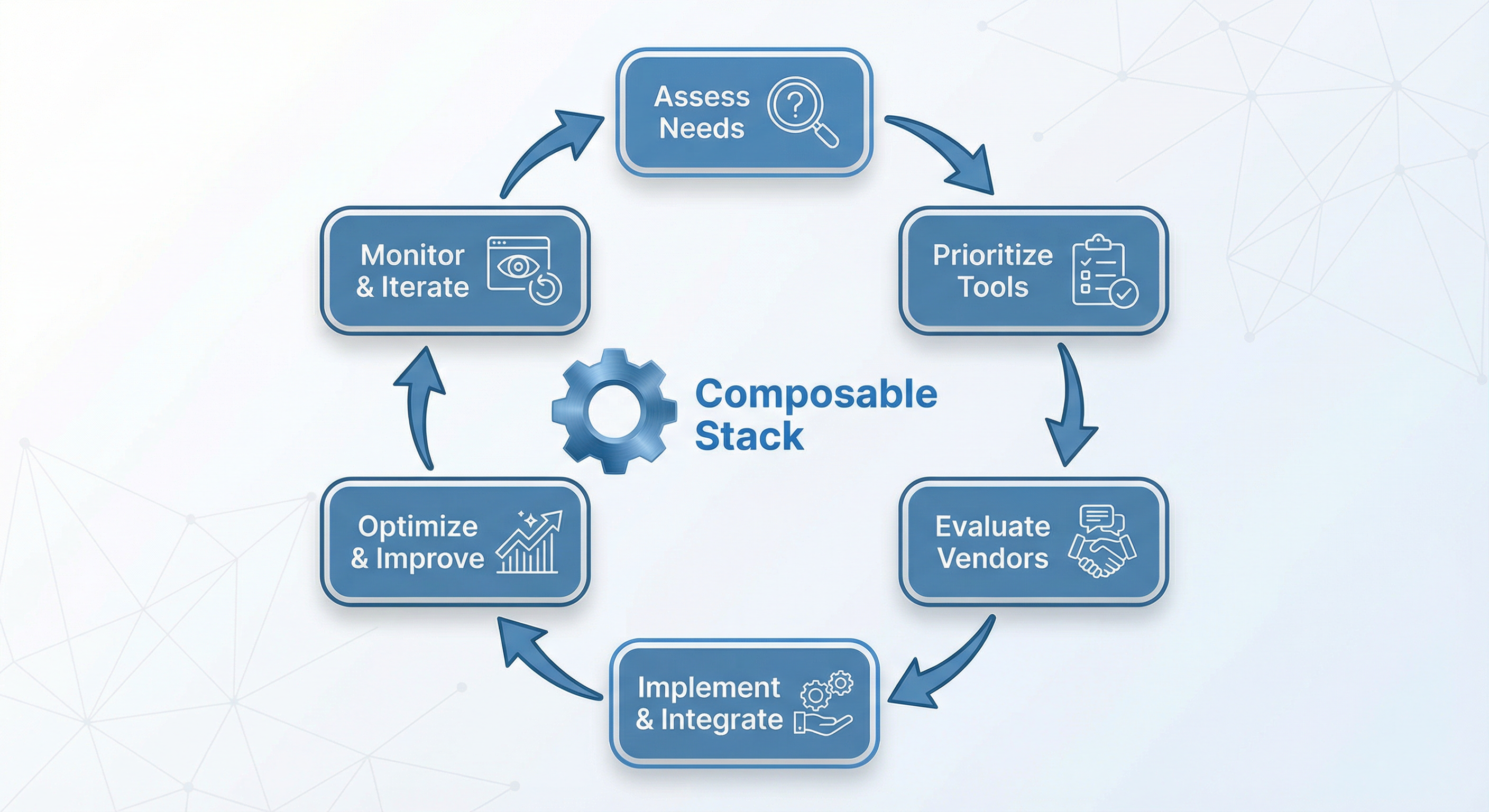
1. Assess
The cycle begins with a thorough assessment of your current marketing technology landscape and business requirements. This involves mapping existing tools, identifying gaps in functionality, understanding data flow patterns, and documenting integration points. You need to evaluate not just what you have, but what you need to achieve your strategic objectives. This assessment should consider technical requirements, business goals, team capabilities, budget constraints, and scalability needs. The goal is to create a clear picture of your current state and desired future state, identifying which components need to be added, replaced, or optimized.
2. Select
With a clear understanding of your requirements, you move to selecting the right solutions. This stage involves researching vendors, evaluating capabilities against your specific needs, and considering factors beyond just feature lists—integration complexity, API quality, vendor stability, pricing models, and support quality. The modular approach allows you to select best-of-breed solutions for each specific function rather than accepting compromises inherent in suite offerings. You can run parallel evaluations, testing multiple vendors simultaneously to compare performance, cost, and fit before making a commitment. This selection process should prioritize solutions that integrate well with your existing infrastructure and align with your long-term architectural vision.
3. Integrate
Integration is where the abstraction layer proves its value. This stage involves connecting new tools to your existing infrastructure through APIs, webhooks, and middleware. The goal is to create seamless data flow between systems while maintaining loose coupling—each component should be able to operate independently and be replaced without disrupting the entire ecosystem. Integration requires careful planning of data schemas, authentication mechanisms, error handling, and monitoring. You'll need to establish data governance rules, ensure data quality standards, and create documentation that enables your team to understand and maintain these connections. The abstraction layer allows you to swap underlying vendors without changing your core workflows, protecting your investment in integration work.
4. Deploy
Deployment involves rolling out new tools and integrations into your production environment. This stage requires careful change management, training your team on new workflows, and ensuring business continuity during the transition. You'll need to establish rollback procedures, create monitoring and alerting systems, and develop documentation for ongoing operations. Deployment should be phased when possible, allowing you to validate each component before moving to the next. This is also where you establish operational procedures—who manages what, how issues are escalated, and how performance is measured. Successful deployment means the new tool is not just installed, but actively contributing value to your marketing operations.
5. Monitor
Once deployed, continuous monitoring ensures your stack is performing as expected and delivering value. This involves tracking system health, data quality, integration performance, cost metrics, and business outcomes. Monitoring should cover technical metrics (API response times, error rates, data sync status) as well as business metrics (campaign performance, customer engagement, revenue attribution). You need visibility into how each component is performing individually and how they're working together as a system. This monitoring enables you to identify issues early, understand usage patterns, and make data-driven decisions about optimization. Regular reviews of vendor performance, cost analysis, and capability assessments help you stay informed about whether your current stack continues to meet your needs.
6. Iterate
The cycle completes with iteration—using insights from monitoring to refine and improve your stack. This might involve optimizing existing integrations, replacing underperforming tools, adding new capabilities, or removing redundant systems. Iteration is where the modular approach's flexibility truly shines: you can make targeted improvements to specific components without requiring a complete system overhaul. This stage involves evaluating new technologies, testing innovative approaches, and continuously aligning your stack with evolving business needs. The iteration phase feeds back into assessment, creating a continuous improvement cycle that keeps your marketing technology infrastructure current, efficient, and aligned with your strategic objectives.
Conclusion
The perfect MarTech stack isn't about having the most tools—it's about having the right tools that work together seamlessly through intelligent integration. By building a modular, decoupled marketing infrastructure, you gain the flexibility to choose best-of-breed solutions, experiment with emerging technologies, and escape vendor lock-in—all while maintaining control over your marketing operations and strategic priorities.
This approach represents a fundamental shift from the traditional suite-based model that has dominated marketing technology for decades. Instead of accepting the limitations and dependencies that come with all-in-one solutions, organizations can now architect marketing infrastructure that matches their specific needs, scales with their growth, and adapts to changing market conditions. The abstraction layer that sits between your business logic and vendor implementations becomes your strategic advantage—it's what enables you to maintain control, preserve flexibility, and build resilience into your operations.
The benefits extend far beyond technical flexibility. When you're not locked into a single vendor's roadmap, you maintain negotiation leverage. When you can run parallel implementations, you can compare vendors head-to-head and make informed decisions based on actual performance rather than marketing claims. When individual components can be optimized or replaced independently, you avoid the cascading failures and system-wide disruptions that plague monolithic suites. Most importantly, you gain the ability to respond quickly to new opportunities, test innovative approaches, and continuously improve your marketing capabilities without waiting for a vendor to build the features you need.
However, this approach is not for every organization. It requires intellectual leadership that understands both marketing strategy and technology architecture. It demands a team capable of managing complexity, evaluating vendor solutions critically, and making strategic decisions about when to build versus when to buy. It requires investment in integration work, ongoing management, and the discipline to maintain documentation and governance. For organizations that operate in reactive, production-line modes focused on executing campaigns rather than building scalable systems, a suite may still be the appropriate choice—but they should understand the trade-offs they're making.
For organizations ready to invest in building a strategic marketing technology capability, the modular approach offers a path to sustainable competitive advantage. You're not just implementing tools—you're building an infrastructure that can evolve, adapt, and scale. You're creating a system where your marketing operations are limited only by your strategic vision and execution capability, not by the constraints of a vendor's product roadmap. In an era where marketing technology moves faster than ever, where new capabilities emerge constantly, and where the cost of being locked into the wrong solution can be devastating, this flexibility isn't just nice to have—it's essential for long-term success.
The journey to a perfect MarTech stack is ongoing. It's not a one-time implementation but a continuous cycle of assessment, selection, integration, deployment, monitoring, and iteration. Each cycle makes your infrastructure stronger, more capable, and better aligned with your business objectives. Start where you are, identify your most critical gaps, and begin building the foundation. With the right team, the right approach, and the right mindset, you can transform your marketing technology from a constraint into a strategic asset that drives growth, innovation, and competitive advantage.